
MAKÜ Faculty of Veterinary Medicine's 20th annual tribute to labor
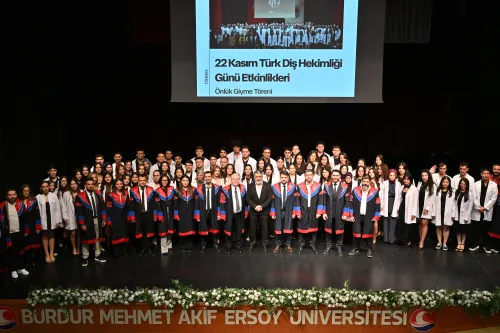
A plaque ceremony was held for the academic and administrative staff who have been serving since the establishment of Burdur Mehmet Akif Ersoy University (MAKÜ) Faculty of Veterinary Medicine and have completed their 20th year of work. During the ceremony, the faculty's academic development, research infrastructure, and specialized studies in animal husbandry were evaluated, and new projects of the university for the future were also shared.
Date | 25 November 2026, Wednesday

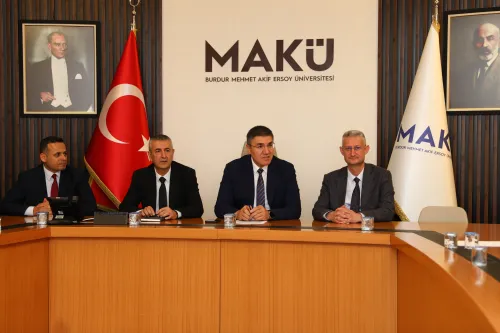
During the academic performance meeting and plaque ceremony held at the MAKÜ Faculty of Veterinary Medicine, the development of the faculty from the past to the present was discussed. In the meeting, Dean Prof. Dr. Mehmet Çağrı Karakurum provided information about the faculty's academic structure, educational opportunities, accreditation processes, and the animal hospital.
The Faculty of Veterinary Medicine continues its development with a strong academic infrastructure
Referring to the history of the faculty, Dean Prof. Dr. Mehmet Çağrı Karakurum noted that there are five departments and 22 main science branches in the faculty, with 55 professors, 19 associate professors, and 19 doctoral faculty members, as well as 16 teaching assistants and research assistants. Stating that doctoral education is provided in the majority of the main science branches, Karakurum expressed that efforts to enhance the faculty's academic capacity are ongoing.
New service units are being added to the Animal Hospital
Recalling that the MAKÜ Animal Hospital was opened in 2015 and received its license in 2019, Karakurum stated that the physical infrastructure and service capacity of the hospital are being improved every year.
After the meeting, Karakurum indicated that the official opening of the Computed Tomography Unit would take place, and a new unit providing dietary services within the animal hospital has also been launched. He noted that these units could serve not only patients from Burdur but also sick animals applying from different regions of Turkey, and that online dietary consulting would be offered if requested.
Karakurum stated that the faculty's EAEVE accreditation is ongoing, and efforts are being made to address some deficiencies identified during the evaluation process, while the VEDEK evaluation visit is planned for the spring of 2027.
Educational and research opportunities are expanding
Referring to the faculty's practical training activities, Karakurum said that mobile clinic practices hold significant importance for students' professional development and societal contribution. He expressed that especially fourth and fifth-year students gain professional experience through practices that support their clinical training outside the faculty.
Karakurum noted that the Cattle Embryo Production Center, Anatomy Museum, library, and international collaborations within MAKÜ also provide significant contributions to educational and research activities, stating that Erasmus+ agreements have reached approximately 35.
Providing information about the faculty's scientific publication activities, Karakurum mentioned that the name of the faculty journal, which has been published four times a year since 2020, was changed to Mediterranean Veterinary Journal to increase its international visibility.
Rector Dalgar: “MAKÜ has reached a point that guides livestock policies”
Rector Prof. Dr. Hüseyin Dalgar stated that the Faculty of Veterinary Medicine has made significant contributions to the university's development with its work discipline and sense of responsibility, noting that MAKÜ's specialized studies in animal husbandry have now found a response at the national level.
Expressing that the good herd and dairy cattle farming certification programs implemented by the university contribute to the policies of the Ministry of Agriculture and Forestry, Rector Dalgar said, “MAKÜ has now reached a point where it guides some policies of the Ministry of Agriculture in Turkey, especially in the field of animal husbandry.”
An artificial intelligence-supported autonomous farm is being established at MAKÜ
Rector Dalgar announced that an autonomous farm has been established by TÜME in the university's farming area, stating that the facility, which will initially host approximately 1,000 large cattle, could reach a capacity of 3,000 heads.
Stating that the farm will be managed with artificial intelligence, robotic systems, and digital software, Rector Dalgar noted that it will create an important application area for students, aiming to guide young people towards technology-based agriculture and livestock entrepreneurship.
Rector Dalgar expressed that young people who will receive training at the farm will be able to benefit from various supports to establish their own technological enterprises.
The Institute of Agricultural and Animal Husbandry Technologies will strengthen research infrastructure
Rector Dalgar stated that the Institute of Agricultural and Animal Husbandry Technologies established within MAKÜ will conduct graduate education and research activities, and that experts in their fields will be brought together at the institute.
Rector Dalgar also announced that the university has received authorization for the Agricultural Technologies Testing Center, stating that agricultural robots and technological systems can be tested and reported.
MAKÜ has an important role in good agriculture and organic agriculture certification
Rector Dalgar stated that they have received authorization in the field of good agriculture and organic agriculture certification through MAKÜ Technology Transfer Office A.Ş., announcing that the university will carry out the control and certification services of good agricultural practices for 17 agricultural enterprises across Turkey affiliated with TİGEM.
“We must guide our veterinary faculty students towards agricultural entrepreneurship”
Emphasizing that veterinary education should not be limited to opening clinics or working in public institutions, Rector Dalgar highlighted the importance of training students to establish technology-based production enterprises.
Rector Dalgar stated that the establishment of the Animal Husbandry Technologies and Management department at MAKÜ Vocational School of Food, Agriculture, and Animal Husbandry is an important step towards this goal, expressing his desire for students to effectively benefit from new farms and research infrastructures.
“We aim for Burdur to transform into a strong ecosystem in livestock”
Prof. Dr. Dalgar stated that they aim to create a strong ecosystem in Burdur in the fields of genetics, embryo production, animal nutrition, and agricultural technologies with MAKÜ's specialized studies, mentioning that work is ongoing for a new Technopark annex building aimed at agricultural technologies.
Rector Dalgar noted that the new structure will provide R&D, product development, and testing opportunities for companies operating in the field of agricultural and livestock technologies, stating, “Burdur will become the center of this business. It will turn into a city where investments are directed from genetics to nutrition, from drug development to technology.”
At the end of his speech, Rector Dalgar thanked the academic and administrative staff of the Faculty of Veterinary Medicine for their efforts, stating that the university will continue to support the development of the faculty with new projects and technological infrastructure.
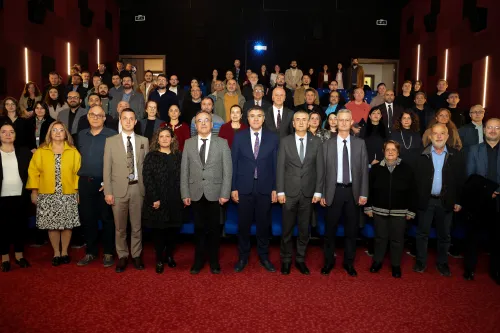
The program concluded with the presentation of plaques to the academic staff who completed their 20th year of work at the university.